CDM Regulations 2015 Explained: Duties, Roles, and How Software Helps
Key takeaways
- CDM 2015 applies to construction projects of all sizes.
- Clients, designers and contractors have distinct health and safety duties.
- Digital tools can help to organise information, but they cannot replace competent people.
Introduction
Each of the parties involved in a construction project (clients, designers and contractors) is required to abide by certain health and safety duties under the Construction (Design and Management) Regulations 2015 (CDM 2015). These regulations have to be adhered to from the planning stage of a construction project to the handover point, and understanding the main regulations will help to ensure that the health and safety of all concerned are protected and that CDM compliance has been achieved.
What are the CDM Regulations 2015?
CDM 2015 is UK legislation covering health, safety and welfare in construction. It applies to building, alteration, maintenance and demolition work. The regulations aim to reduce foreseeable risks by making teams consider safety early, coordinate decisions and share relevant information throughout a project.
They apply to domestic and commercial projects, although some client duties on domestic projects transfer to other dutyholders. Arrangements should be proportionate to the project's scale and risks; small jobs still need proper planning.
Who has duties under CDM 2015?
CDM 2015 assigns duties to several roles. One person or organisation may hold more than one role.
- Client
The client commissions the work. They must make suitable management arrangements, allow sufficient time and resources, provide pre-construction information and appoint a principal designer and principal contractor when more than one contractor is involved.
- Principal designer
The principal designer coordinates health and safety during the pre-construction phase. They help eliminate or reduce foreseeable design risks and share relevant information.
- Principal contractor
The principal contractor coordinates health and safety during construction on projects involving multiple contractors. They prepare the construction phase plan, coordinate contractors, provide inductions and ensure welfare arrangements.
- Designers and contractors
Designers consider design risks and communicate information for safe construction and maintenance. Contractors plan and supervise work, use competent workers and cooperate with others. Workers follow site arrangements and report hazards.
What documents and notifications are needed?
Key project information commonly includes:
- Pre-construction information (PCI): Site details, existing hazards and constraints.
- Construction phase plan (CPP): Arrangements for managing health and safety during construction.
- Health and safety file: Residual-risk information relevant to future work on the structure.
- F10 notification: Notice to the Health and Safety Executive (HSE) when a project meets the statutory threshold.
A project is notifiable if it is expected to last longer than 30 working days and have more than 20 workers on site simultaneously at any point, or exceed 500 person-days. The client holds the legal duty to notify the HSE, although another person may submit it on the client's behalf. Notification does not replace other CDM duties.
How can software support CDM management?
Scattered emails, spreadsheets and folders make it harder to check appointments, find current information and follow up actions. Suitable CDM software can bring records and workflows together, making information easier to find and share.
SiteChief's CDM functionality includes dutyholder appointment workflows and competency verification, a pre-construction information register, construction phase plan support, F10 notification workflows, design risk tracking and health and safety file compilation. These features support a consistent process from project setup to handover.
Why use digital construction safety tools?
Effective construction safety management systems go beyond simply storing documents; they allow teams to:
- Improve visibility: Track records, responsibilities, and outstanding actions.
- Strengthen coordination: Share relevant information with project participants.
- Support traceability: Retain clearer records of updates and decisions.
- Standardise processes: Follow repeatable workflows across sites.
Dutyholders are still accountable for their choices, assessing if systems are operational and overseeing work on site. Software can be used as a tool to help with this; however, it does not take over anyone’s legal duties.
Conclusion
When you think about safety first, have clear responsibilities, and keep your information current as long as possible, then you will get the most out of CDM 2015. To comply with CDM, individuals must apply the regulations, rather than just filling out forms. When you use the correct CDM software, it makes coordinating all this much easier. Also, when you have an effective construction safety management system in place, you are connecting your documentation to the everyday activities on-site.
Use SiteChief's CDM Compliance module to manage your appointments, project data, and handover records in one organised place.
Further reading: What is CDM 2015? A guide for construction professionals.
Frequently asked questions
Do CDM Regulations 2015 apply to small projects?
Yes. CDM 2015 applies to projects of all sizes. Arrangements should reflect the work and its risks.
Is a construction phase plan required for every project?
Yes. Every project needs a plan before construction begins. The contractor prepares it on a single-contractor project; the principal contractor is responsible where multiple contractors are involved.
Who is responsible for submitting an F10?
The client has the legal duty to notify the HSE when the threshold is met. Another person may submit it on the client's behalf.
Can software make a company compliant?
No. Digital tools support records, coordination and oversight, but cannot assume dutyholders' legal responsibilities or replace competent judgement.
Related Articles
Fire Risk Assessments: How Often Are They Legally Required, and What Should They Cover?
Learn how often a fire risk assessment is legally required, what it must cover, and how fire risk assessment software supports fire compliance.
LOLER Inspections: Frequency, Requirements, and Record-Keeping Best Practice
LOLER inspections explained: how often to inspect lifting equipment, what the law requires, and how safety inspection software simplifies records.
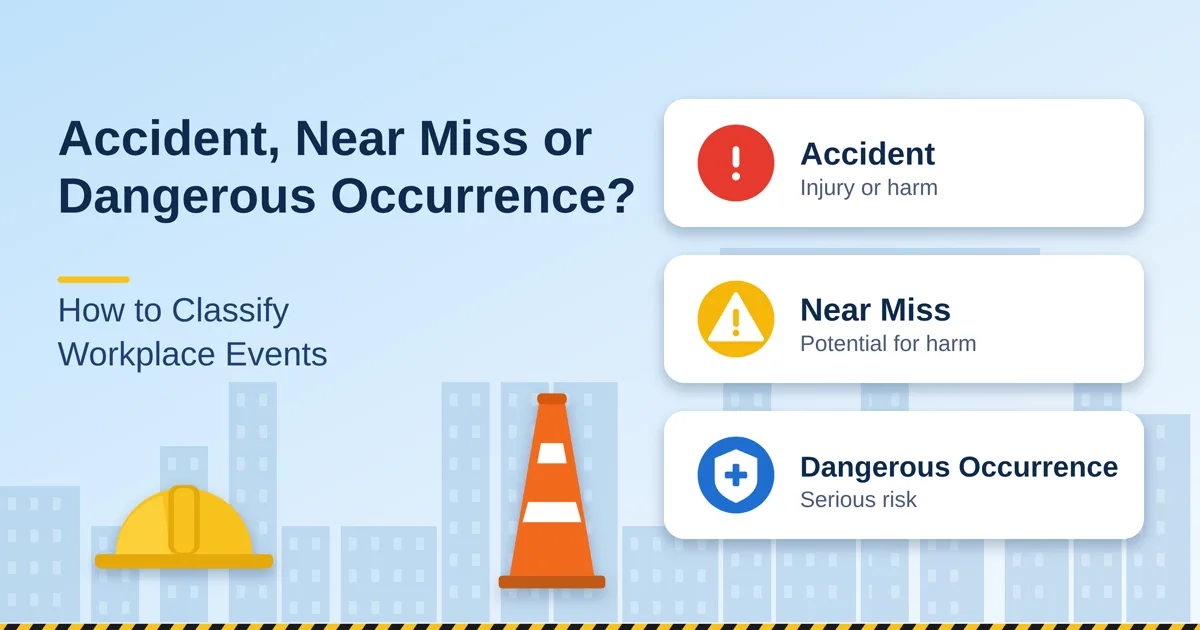
Accident, Near Miss or Dangerous Occurrence? How to Classify Workplace Events
Learn how to classify workplace events and strengthen incident reporting with clear definitions for accidents, near misses and dangerous occurrences.