
Complete Guide to RIDDOR Reporting in the UK
The Reporting of Injuries, Diseases and Dangerous Occurrences Regulations 2013 (RIDDOR) is a legal requirement that every employer in Great Britain must understand and comply with. Failure to report incidents correctly can result in enforcement action from the Health and Safety Executive (HSE) and substantial fines. For the full requirements, see the HSE RIDDOR guidance.
In 2025/26, 126 workers were killed in work-related accidents in Great Britain, a provisional figure, compared with a finalised 128 in 2024/25 (HSE).
What is RIDDOR?
RIDDOR 2013 requires employers, the self-employed, and people in control of work premises to report certain serious workplace accidents, occupational diseases, and specified dangerous occurrences (near misses) to the HSE or the relevant enforcing authority.
The purpose of RIDDOR is twofold: to enable the HSE to identify where risks arise and to investigate serious accidents, and to maintain a statistical record of workplace incidents across Great Britain.
In 2024/25, an estimated 680,000 workers reported a non-fatal injury at work, and 59,219 employee injuries were reported under RIDDOR (HSE). The two figures count different things: the first is a self-reported survey estimate, the second is what employers actually reported.
All RIDDOR reports must be submitted via the HSE's official RIDDOR reporting portal, which provides step-by-step guidance and immediate submission confirmation.
What Must Be Reported?
Not every workplace incident requires a RIDDOR report. The regulations specify exactly which events must be reported:
- Deaths: All work-related deaths must be reported immediately
- Specified Injuries: Including fractures (except fingers, thumbs, and toes), amputations, permanent loss of sight, crush injuries to the head or torso, and serious burns (see the list of specified injuries)
- Over-7-Day Incapacitation: Injuries where an employee is unable to perform their normal work duties for more than seven consecutive days. Slips, trips and falls on the same level account for around 30% of non-fatal injuries reported under RIDDOR (HSE)
- Occupational Diseases: Specific diseases linked to workplace exposure, such as occupational asthma, dermatitis, or hand-arm vibration syndrome (see reportable occupational diseases). Work-related ill health affected an estimated 1.9 million workers in 2024/25, about half of it stress, depression or anxiety, which is generally not RIDDOR-reportable. Reportable lung disease is a larger part of the picture: around 22,000 new breathing or lung problems, and 2,146 mesothelioma deaths in 2024 (HSE)
- Dangerous Occurrences: Near-miss events with the potential to cause serious harm, such as collapse of scaffolding or explosion of a pressure vessel
Reporting Timelines
Understanding reporting deadlines is critical for compliance. Missing a deadline can be considered a breach of regulations:
- ▸Deaths and Specified Injuries: Report by "the quickest practicable means" (telephone or online) and submit a written report within 10 days
- ▸Over-7-Day Incapacitations: Report within 15 days of the accident
- ▸Dangerous Occurrences: Report immediately when discovered
- ▸Occupational Diseases: Report as soon as diagnosis is confirmed
How to Report
The HSE provides an online reporting system accessible at HSE online RIDDOR reporting. Reports can also be made by telephone (0345 300 9923) for deaths and specified injuries only. The online system is available 24/7 and provides immediate confirmation of submission.
Your report must include: Date, time, and location of the incident; details of the person affected; nature of the injury or disease; and a brief description of what happened and the work activity involved.
Record Keeping Requirements
Beyond reporting to the HSE, employers must maintain their own records of RIDDOR incidents. These records must be kept for a minimum of three years and should include: the date and method of reporting, the date, time and place of the event, personal details of those involved, and a brief description of the nature of the event or disease.
Common Compliance Pitfalls
HSE estimates that employers report only around half of RIDDOR-defined non-fatal injuries to employees; the reported rate in 2024/25 was 209 injuries per 100,000 employees.
Many organisations struggle with RIDDOR compliance due to confusion over what qualifies as a reportable incident, missed reporting deadlines, or incomplete documentation. The seven-day incapacitation rule is particularly prone to error—remember that this counts consecutive days the worker was incapacitated, not necessarily working days, and the day of the accident is not included in the count.
Leveraging Technology for Compliance
Work-related ill health and injury caused an estimated 40.1 million working days lost in 2024/25 (HSE). Modern safety management platforms can automate much of the RIDDOR process. When an incident is logged, AI-powered systems can assess whether it meets RIDDOR criteria, calculate reporting deadlines, pre-fill report forms with captured data, and maintain compliant records automatically. This reduces the administrative burden while virtually eliminating the risk of missed reports or incomplete documentation.
RIDDOR compliance doesn’t have to be complicated. Workplace injury and new cases of ill health cost Great Britain an estimated £22.9 billion in 2023/24 (HSE). With clear processes, proper training, and the right tools, you can ensure your organisation meets its legal obligations while maintaining a comprehensive record of workplace safety performance.
Frequently Asked Questions
What is RIDDOR?
RIDDOR is the Reporting of Injuries, Diseases and Dangerous Occurrences Regulations 2013. It requires employers, the self-employed and people in control of work premises to report certain serious workplace accidents, occupational diseases and dangerous occurrences to the HSE or the relevant enforcing authority.
What incidents must be reported under RIDDOR?
You must report work-related deaths, specified injuries (such as most fractures, amputations, loss of sight, serious burns and crush injuries to the head or torso), injuries causing more than seven consecutive days of incapacity, certain occupational diseases and specified dangerous occurrences.
What are the RIDDOR reporting deadlines?
Deaths, specified injuries and dangerous occurrences must be reported without delay. Over-7-day incapacitations must be reported within 15 days of the accident. Occupational diseases are reported as soon as reasonably practicable after you receive a written diagnosis from a doctor.
How do I submit a RIDDOR report?
Use the online reporting form on the HSE website, which is available 24/7 and gives confirmation of submission. For deaths and specified injuries only, you can also report by telephone to the HSE Incident Contact Centre on 0345 300 9923.
How long must RIDDOR records be kept?
Employers must keep their own records of RIDDOR incidents for at least three years. Records should include the date and method of reporting, the date, time and place of the event, personal details of those involved and a brief description of what happened.
Related Articles
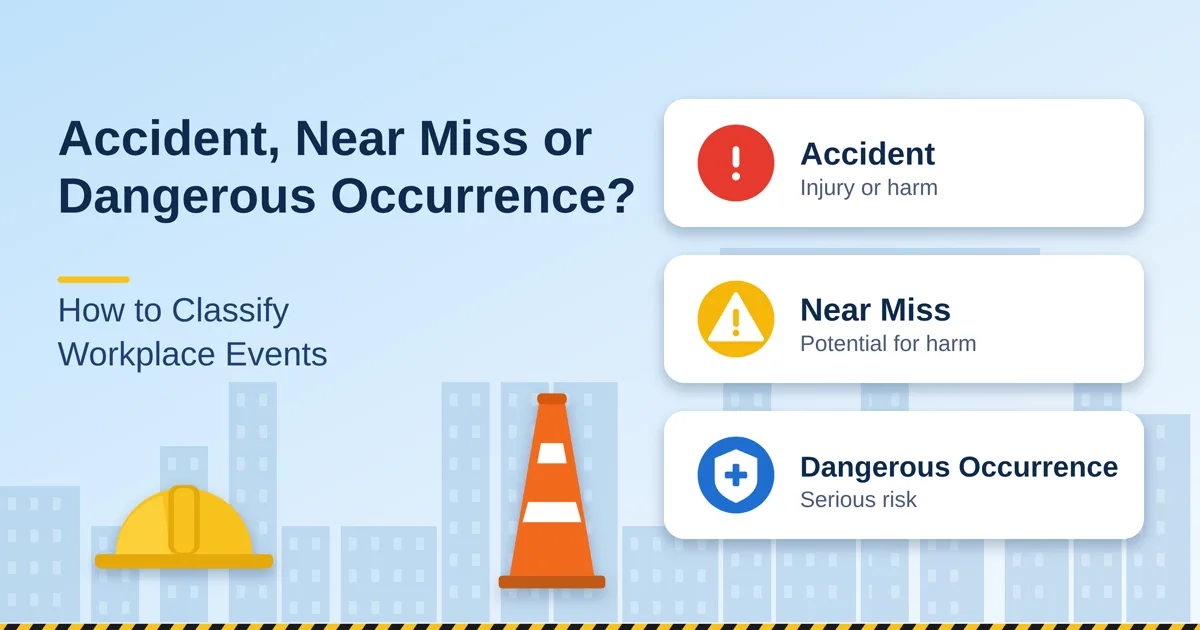
Accident, Near Miss or Dangerous Occurrence? How to Classify Workplace Events
Learn how to classify workplace events and strengthen incident reporting with clear definitions for accidents, near misses and dangerous occurrences.
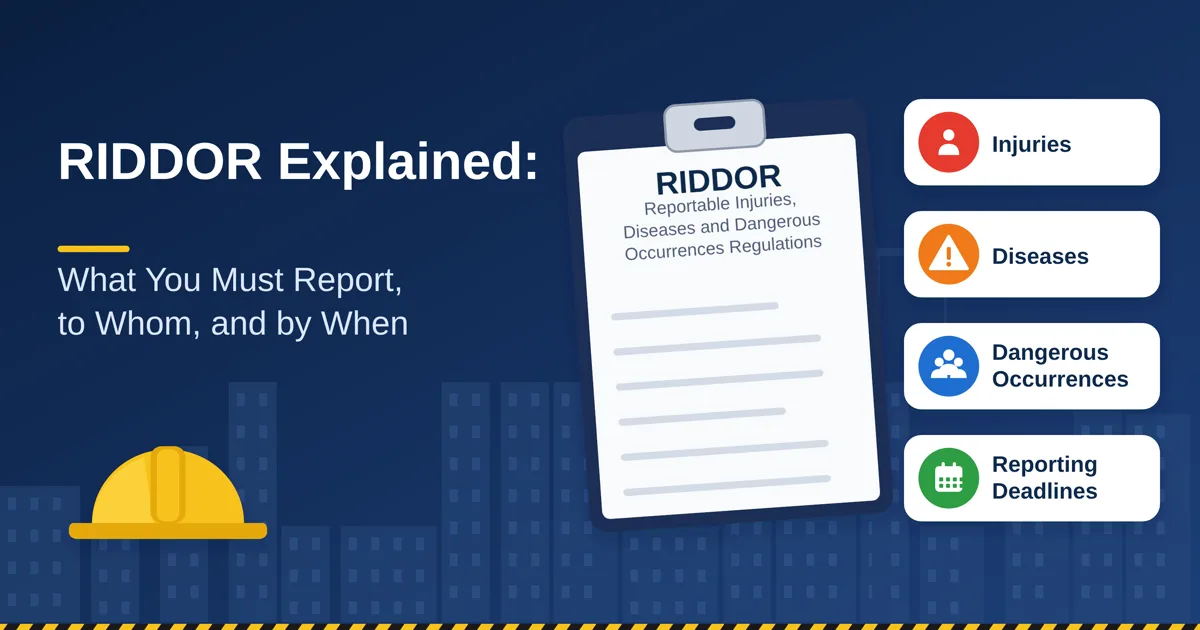
RIDDOR Explained: What You Must Report, to Whom, and by When
Learn what workplace incidents must be reported under RIDDOR, who reports them and when, with guidance on incident reporting and compliance.

What Is a RIDDOR Reportable Incident? A Plain-English Guide
Learn which workplace incidents are reportable under RIDDOR, who must report them and how RIDDOR compliance software supports reporting.