
From Root Cause to Resolution: Building a CAPA Process for Health & Safety
Key Takeaways
- CAPA connects incident investigation with corrective and preventive action.
- Identifying the root cause helps organisations address problems beyond the immediate hazard.
- Verification is essential for determining whether an action actually resolves the underlying issue.
- Digital tools can connect incident reporting, investigations, corrective actions, and follow-up in one workflow.
A workplace incident does not necessarily end when the immediate hazard has been controlled. The investigation that follows can reveal gaps in procedures, training, equipment, supervision, or other safety controls. Without a structured process for addressing those findings, organisations may fix the visible problem while leaving the underlying cause unresolved.
A Corrective and Preventive Action (CAPA) process provides a framework for moving from an identified problem to a documented resolution. When properly implemented, it connects incident reporting, root cause analysis, action assignment, implementation, and verification.
What Is CAPA in Health and Safety?
CAPA is a system which follows a logical sequence of identifying a problem, finding the cause of the problem, applying corrective action, and, if possible, taking preventative action.
It's helpful to be able to tell the difference between an immediate correction and a corrective action. If a piece of equipment is damaged, it may remove a current hazard. Examining the cause of the damage to the equipment, why it was not discovered before it happened and whether other equipment is in the same danger is looking at the problem at another fundamental level.
The objective is not simply to record that something went wrong. It is to understand the conditions that allow it to happen and determine what needs to change.
Step 1: Capture the Incident or Finding
Every CAPA process begins with reliable information.
The initial record should capture relevant details about what happened, where it occurred, who was involved, the immediate consequences, and any actions taken at the time. Depending on the event, photographs, witness accounts, inspection of records, equipment information, and other supporting evidence may also be relevant.
This information creates the foundation for the investigation. If important details are missing at the beginning, investigators may have difficulty determining contributing factors later.
Digital incident management software can help standardise this initial stage by providing structured reporting workflows. Instead of relying entirely on emails, paper forms, or disconnected spreadsheets, safety teams can maintain incident information in a central system.
Step 2: Investigate the Root Cause
Identifying what happened is different from understanding why it happened.
Consider a worker who was injured because a required procedure was not followed. The investigation should not necessarily end with “employee failed to follow procedure.” That finding may simply describe immediate action.
A deeper investigation could ask whether the procedure was accessible, whether employees had received appropriate training, whether the required equipment was available, whether workplace conditions encouraged shortcuts, or whether similar issues had been identified previously.
These practices like 5 Whys and Fishbone analysis can assist in the review of contributing factors and get to the bottom of incidents.
The result should be a root-cause assessment that provides a reasonable basis for deciding what needs to change.
Step 3: Define Corrective and Preventive Actions
Once the causes are understood, the organisation can determine appropriate actions.
An effective corrective action should be specific. “Improving employee awareness” is difficult to measure because it does not establish what will actually change. A more useful action could identify a procedure that needs revision, the employees who require training, the responsible person, and the evidence needed to demonstrate completion.
Each action should ideally have:
- A clearly defined task
- An assigned owner
- A target completion date
- A priority level
- Supporting documentation
- A defined verification method
Preventive actions may also be appropriate when an investigation identifies a broader vulnerability that could affect other teams, locations, processes, or equipment.
Step 4: Track Corrective Actions
Creating corrective actions is only one part of CAPA. Organisations also need to know whether those actions were completed.
Corrective action tracking software can be of practical use here. A central system can be used to help a safety team assign the actions, keep track of deadlines, document progress, and find overdue items.
It can also help the management to have a better understanding of the safety issues that still need to be resolved. Visibility can help organisations identify corrective actions that are consistently produced in a specific location, department or hazard type, for organisations operating in several facilities.
Most importantly, action tracking helps to maintain the investigation in relation to the resolution. A corrective action should not be placed into another spreadsheet where it gets lost after the incident record has been closed.
Step 5: Verify That the Solution Worked
A completed task is not necessarily an effective corrective action.
Verification asks whether the implemented change actually addresses the underlying problem. Depending on the situation, this could involve a follow-up inspection, reviewing subsequent incidents, testing a revised procedure, confirming that physical control remains effective, or checking whether employees understand a new process.
This creates a complete CAPA cycle:
Incident or finding → Investigation → Root cause → Corrective action → Implementation → Verification
If the same problem occurs again, the organisation may need to revisit the original analysis rather than simply create another identical action.
Connecting CAPA With Incident Management
CAPA becomes more useful when it is connected directly to incident investigation.
An accident management software platform can bring together incident reports, investigation findings, root causes, corrective actions, assigned owners, deadlines, supporting evidence, and closure information. This creates a clearer record of how the organisation responded to an event.
SiteChief brings incident reporting and investigation workflows together with corrective action management, helping organisations maintain a connected process from reporting through follow-up.
The value of this approach is visibility. Safety teams can examine individual incidents while also looking for patterns across their broader incident data.
Building CAPA Into the Safety Culture
CAPA should not become another administrative exercise that exists only to satisfy an audit requirement.
The process is more effective when organisations use corrective action data to identify recurring problems. Repeated findings involving the same hazard, location, process, or root cause may indicate that previous actions were too narrow or were not adequately verified.
Safety leaders can review overdue actions, recurring incidents, common root causes, and unresolved findings to identify where additional attention may be necessary.
This also changes how organisations view incidents. Instead of treating an incident report as the endpoint, the report becomes the starting point for organisational learning.
From Finding to Resolution
A strong CAPA process creates a clear connection between an event and the changes that follow it. The organisation records what happened, investigates why it happened, assigns appropriate actions, tracks implementation, and verifies the result.
Technology can support that process, but the underlying methodology still matters. CAPA software in health and safety is most useful when it reflects a well-defined process rather than simply digitising an existing collection of disconnected tasks.
For safety teams, the goal is straightforward: identify problems thoroughly, address their underlying causes, and establish evidence that corrective actions have made a meaningful difference.
FAQs
1. What does CAPA mean in health and safety?
CAPA stands for Corrective and Preventive Action. It is a structured process used to investigate problems, address their underlying causes, implement corrective measures, and reduce the likelihood of similar problems occurring again.
2. What is the difference between a correction and a corrective action?
A correction addresses an immediate problem, while a corrective action addresses the cause behind that problem. For example, replacing damaged equipment may correct an immediate hazard, while investigating why the damage occurred can help determine what broader action is needed.
3. How does corrective action tracking software help safety teams?
It can help organisations assign corrective actions, establish deadlines, monitor progress, store supporting evidence, and identify overdue items. Centralised tracking can also provide greater visibility across departments or locations.
4. Why is root cause analysis important in CAPA?
Root cause analysis helps organisations move beyond the immediate circumstances of an incident or finding. Understanding contributing factors can lead to corrective actions that address weaknesses in procedures, training, equipment, or other safety controls.
Related Articles
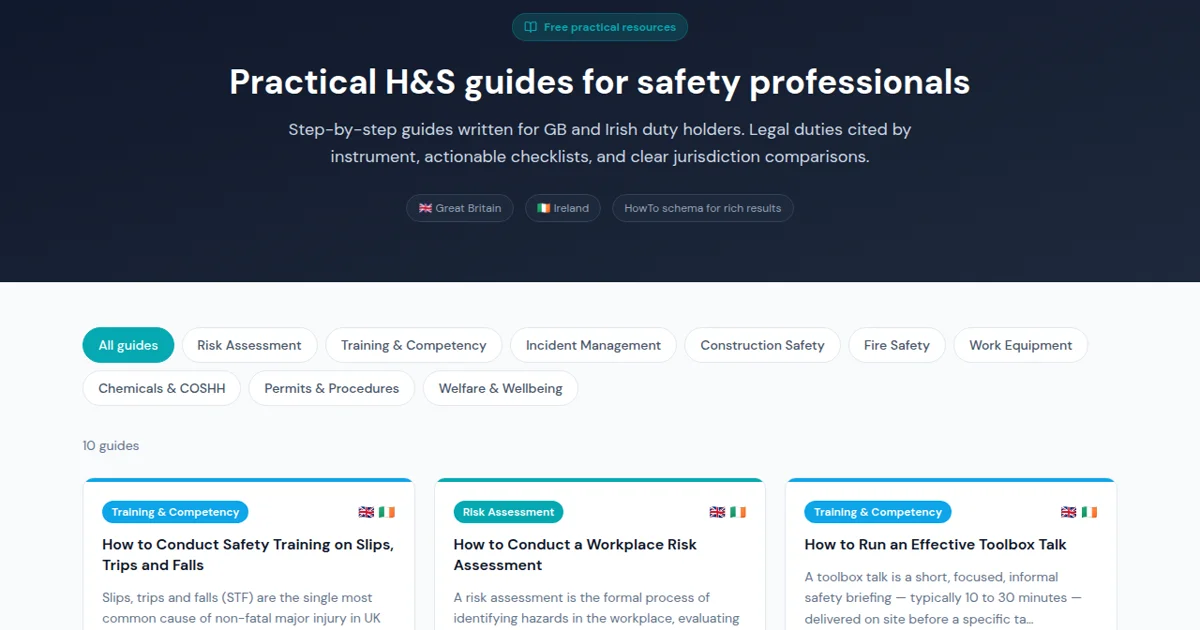
How H&S Guides Help Safety Managers and Teams Meet Their Compliance Duties
SiteChief free H&S Guides give safety managers step-by-step how-to frameworks across risk assessment, incident management, construction safety, fire, COSHH and more — with legal citations, checklists and jurisdiction comparisons.

Health and Safety Software for Schools: A Guide for Business Managers and SBMs
A practical guide for business managers and SBMs on selecting health and safety software for schools, covering compliance and safeguarding needs.

Incident reporting software comparison: UK guide 2026
Discover our incident reporting software comparison for UK workplaces. Explore top options like SiteChief, SafetyCulture, and more.